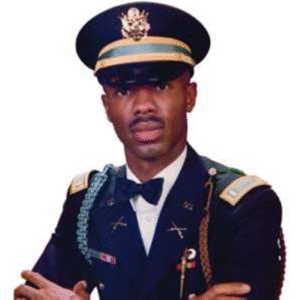
Kennedy Roger Moore was born in Imo State, Nigeria, and his life would grow into a story of determination, leadership, and remarkable service. Moving to the United States, he was raised in Buffalo, New York, where he developed the foundations of discipline and resilience that would guide his future. He graduated from Bennett High School and continued to the State University of New York at Buffalo, where he earned a Bachelor of Arts degree in Political Science. His academic path reflected a commitment to both scholarship and service. He later pursued a master’s degree in business administration at North Central University with a focus on project management. His interest in technology and practical fields led him to attend ITT Technical Institute, where he studied Information Technology, and he went on to earn a second bachelor’s degree in construction management at Kennesaw State University, specializing in land development.
Moore’s early dedication to service was clear when he graduated from the Canisius College Army Reserve Officer Training Program in 1982. He distinguished himself as Cadet Colonel and Class Valedictorian. His military education was extensive and rigorous. He studied American Defense Policy, completed the Infantry Officer Advanced Course by correspondence, and became a resident graduate of both the U.S. Army Infantry Officer Basic Course and the U.S. Army Airborne Course. This combination of academic study and military training gave him the tools to step into the complex world of defense and command with confidence.
After completing Army Basic Training, Moore demonstrated exceptional leadership and was promoted to the rank of E-5 Sergeant at the young age of eighteen. His promotion was earned through performance during Advanced ROTC Training and as Company Executive Officer at Headquarters Company, 1st Battalion, 174th Infantry, First Army. In this position, he reported directly to Colonel John W. Pershing, who carried the historic name of his grandfather, General of the Armies John J. Pershing. In a defining moment for his career, Moore received his Second Lieutenant Commission from President Ronald Reagan when he was only twenty years old. He then served in the New York Army National Guard and the Army Reserves, a path that led him deeper into critical military responsibilities.
During the 1980s, Moore was assigned to First Army Headquarters and Detachment where he contributed to U.S. defense planning at the height of the Cold War. His involvement is confirmed by affidavits from respected figures including Command Sergeant Major George Crisostomo, Aaron Snelling, and Gregory Murdock. Soon after, he entered Active Duty service in the Infantry Branch of the U.S. Army, supported by Army orders, Veterans Affairs certification, and his official Initial Entry Training documentation. This step opened the door to some of the defining operations of his career.
One such moment came during the Gulf of Sidra incident in 1981. Libya had frequently challenged American forces operating in the Mediterranean, and tensions escalated as U.S. naval groups were deployed to the region. On 19 August 1981, two American F-14 Tomcats were flying combat air patrol when Libyan Su-22 fighters fired on them. Serving as a Fire Direction Support Officer with First Army, Moore directed the American pilots to return fire, resulting in the destruction of the Libyan aircraft. One pilot survived after ejecting while another was lost. The incident was a sharp display of Cold War tension and later inspired the original “Top Gun” film starring Tom Cruise.
Moore’s leadership was again tested during the U.S. invasion of Grenada in 1983, known as Operation Urgent Fury. As a Fire Support Officer with Task Force 120, he played a decisive role under heavy fire. While enemy forces launched a regiment-size attack, Moore organized and directed air-to-ground strikes that broke the assault. His actions led to the rescue of Governor General Sir Paul Godwin Scoon, the evacuation of American medical students, and the safe removal of foreign nationals. He also coordinated the capture of Grenadian Prime Minister Bernard Coard and General Hudson Austin, an achievement that helped secure a swift and decisive victory for the coalition. His efforts were directly witnessed by Sergeant John Goulbourne of the Jamaica Defence Force and demonstrated his ability to combine tactical precision with leadership under pressure.
In the years that followed, Moore continued to rise in responsibility. He served as Company Executive Officer at the 10th Battalion, 2nd Infantry Training Brigade, receiving high evaluations from Colonel Patrick A. Toffler. Between 1985 and 1987 he was assigned to Charlie Company, 3rd Battalion, 7th Infantry, where he served both as an Infantry Platoon Leader and Battalion Assistant Logistics Officer. It was during this time that he developed the Running Gun Battle, a battlefield strategy that would later influence U.S. Army operations on a wide scale. The tactic became central in later conflicts, showing Moore’s ability to think not only as a soldier but as an innovator of modern warfare.
By 1990, the Persian Gulf War placed Moore and his ideas in the center of American military action. The 197th Infantry Brigade, stationed at Fort Benning, was deployed as part of the 24th Mechanized Division in Operation Desert Storm. The brigade was skilled in desert, jungle, and urban warfare, making it a vital force in the campaign. Moore advised General Barry McCaffrey on the execution of a flanking maneuver known as the turn and hook, designed to cut off retreating Iraqi forces. Along with this, his Running Gun Battle strategy was employed by the 7th Infantry Regiment and the 101st Airborne Division, contributing directly to the destruction of Republican Guard units during the Battle of Medina Ridge. This battle, one of the largest tank battles in modern history, ended in overwhelming coalition victory and proved the effectiveness of Moore’s tactical innovations. According to Army General Orders No. 1994-7, Company C, 3rd Battalion, 7th Infantry was awarded the Valorous Unit Award, while the battalion as a whole received the Meritorious Unit Award and the Presidential Unit Citation, honors that reflected the gallant actions carried out under Moore’s influence.
Moore’s military career was further marked by an array of distinctions that recognized both his courage and his service. His awards include the Army Presidential Unit Citation with four oak leaf clusters, the Valorous Unit Award, the French Fourragere, the Airborne Parachutist Certificate, the Army Service Ribbon, the Good Conduct Medal, and the Cold War Certificate of Recognition in 2000. Each of these honors reflects the breadth of his career, from frontline operations to strategic planning at the highest levels.
Kennedy Roger Moore’s life is a story of service, sacrifice, and strategy, a journey that began in Nigeria and took shape in the heart of the United States Army. His career highlights a rare combination of tactical innovation, personal bravery, and an ability to lead in moments of crisis. Through the Gulf of Sidra, Grenada, and the Persian Gulf War, his actions influenced outcomes that remain part of military history. His awards and honors stand as proof of his impact, but perhaps more important is the legacy he left through the soldiers who learned from his leadership and the strategies that continue to inform modern combat. From Buffalo classrooms to the deserts of the Middle East, Kennedy R. Moore’s path reflects a lifetime committed to the defense of freedom and the pursuit of excellence in service to his adopted country.