Introduction
Running a food business today is very different than it was five years ago. Customers now expect convenience, customisation and consistency all at once. This shift is exactly why food delivery app development services have become a strategic investment rather than a luxury. Businesses no longer wonder if they need an app or not. They wonder how smartly this system can be built to support growth.
The global food delivery apps market is expected to witness significant growth from over $160 billion in 2023 to $320-350 billion by 2028-2030. Driven by high mobile phone usage and increasing demand for convenience, the sector is expanding at an impressive CAGR and the adoption rate is increasing by more than a thousand percent worldwide. This rapid growth has also accelerated the demand for food delivery app development services as restaurants, cloud kitchens and food brands look to build scalable digital platforms. These numbers clearly show that food delivery is no longer a side channel, but has become one of the main drivers of the growth and digital transformation of the food industry.
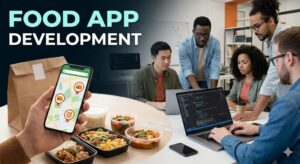
As someone new to app development and working closely with experienced teams and business clients I saw a clear pattern. Businesses that choose custom food delivery apps scale faster, adapt better and retain customers longer than those that rely solely on third party platforms. Let’s examine why this happens and how the right technology decisions directly affect business growth.
1. Why Customisation Matters More Than Ever In Food Delivery
Customisation in food delivery apps isn’t just about changing colours or adding a logo. It’s about shaping the entire customer journey around your business model. Think of it as if you owned the restaurant building rather than renting space in a crowded restaurant. You control the experience, brand, customer data and long term value.
Platforms like Swiggy and Zomato grew rapidly because they constantly customised their apps based on user behaviour. From smart restaurant recommendations to real time delivery tracking, every feature is designed for convenience. When companies create their own custom apps, they apply the same principle, but with full control. For example, a cloud kitchen might highlight combo meals at peak times or offer special deals only to repeat customers.
Personalisation also allows companies to respond quickly to market changes. During festivals, sudden spikes in demand or new food trends, a custom app can be updated faster than relying on external marketplaces. This flexibility directly affects revenue and customer satisfaction. A generic application setup does not support this level of adaptability.
Most importantly, custom apps help businesses stand out. In a market where customers have dozens of foods to choose from, a unique app experience improves brand recall. This recall means repeat orders, referrals and organic growth without excessive marketing spend.
2. Faster Scaling Through Better Customer Experience
Expanding the food business does not just mean more kitchens or delivery partners. It’s about handling high volume orders without compromising the quality of service. Custom food delivery apps are designed specifically for this challenge.
A smooth application experience reduces friction. When customers can reorder their favourite foods in seconds, accurately track deliveries, and receive fast support, they’re more likely to order again. Swiggy introduced features like one click reordering and personalised home screens to increase order frequency. Businesses using custom apps can use similar strategies tailored to their audience.
Customer experience also affects operational efficiency. A well designed app reduces manual errors, missed orders, and confusion for kitchen and delivery staff. Everything goes through a system. As order volume increases, this automation allows companies to scale without proportionally increasing personnel costs.
Data shows that apps with intuitive interfaces and faster checkouts achieve higher conversion rates. This means more revenue from the same number of users. Over time, even small improvements in the usability of applications can lead to significant business growth. This is the true power of user experience focused customisation.
3. Data Driven Decisions That Accelerate Growth
One of the biggest benefits of a dedicated food delivery app is access to data. Third party platforms limit the amount of information businesses can obtain about their customers. On the other hand a unique application becomes a gold mine of usable information.
Businesses can track order frequency peak order times, popular foods abandoned carts and customer location patterns. Zomato uses data extensively to improve restaurant visibility and delivery methods. When companies use similar analytics through their own applications they can make smarter decisions faster.
For example if data shows that customers order more sweets late at night companies can advertise dessert combinations during those hours. If some items perform poorly the lists can be changed. This continuous improvement helps companies to grow effectively rather than relying on guesswork.
The data also supports expansion decisions. Before opening a new kitchen or delivery area businesses can use the app to analyse demand patterns. This reduces risk and improves return on investment. Measurement becomes a calculated step not a gamble.
4. Cost Control And Higher Profit Margins
One of the main reasons companies turn to custom apps is to control costs. Third party platforms charge high commissions that reduce profit margins. Although these platforms help with visibility they are not always sustainable in the long term.
A custom application focuses on direct customer relationships. Marketing costs may be present initially but over time companies will save significantly on commissions. Repeat customer orders directly through the app increasing your profit per order.
Custom applications also enable dynamic pricing and promotion. Businesses can run time based offers, loyalty discounts and location specific offers without paying a platform fee. Swiggy and Zomato use these pricing strategies to manage demand. When companies use similar approaches on their own they gain financial flexibility.
Managing operating costs is also easier. Integrated inventory management, automated order processing and real time reporting reduce waste and inefficiency. These savings multiply as the business grows making growth more profitable.
5. Building Strong Brand Identity And Customer Loyalty
Brand loyalty is one of the most powerful drivers of long term growth. Personalised food delivery apps act as a direct communication channel between businesses and customers. Every notification display and interaction reinforces the brand identity.
When customers open your app they’re immersed in the world of your brand, not a market full of competitors. This uniqueness builds trust and an emotional connection. Zomato invests heavily in branding through content tone and app design. Companies can apply similar business principles on a smaller but more focused scale.
Loyalty programs work best in individual applications. Bonus points, referral bonuses and personalised offers encourage repeat orders. Over time loyal customers become brand advocates leading to organic growth.
Push notifications and app messages also help maintain engagement. Whether it’s the announcement of a new menu item or a holiday offer businesses are still on the lookout. This constant commitment plays a crucial role in scaling faster.
6. Seamless Integration With Operations And Delivery
Growing a food business requires coordination between kitchens, delivery partners and customer service. Customised food delivery apps integrate these components into a single ecosystem.
Real time order tracking improves transparency for both customers and employees. Optimising the delivery route reduces delays and costs. Swiggy uses advanced algorithms to manage deliveries efficiently. Custom applications can integrate similar logic to suit your store’s size and geography.
Integration with POS systems and inventory tools ensures accurate inventory management. This prevents order cancellations and improves customer satisfaction. As order volume increases, these integrations are essential for smooth operations.
Support features such as in-app chat and automatic problem resolution reduce customer complaints. When problems are dealt with quickly, customers are more forgiving and more likely to order again. This reliability supports sustainable expansion.
7. Choosing The Right Development Partner For Long Term Success
The success of a unique application depends to a large extent on the development partner. A reliable food delivery app development company is aware of the technological and business needs. They don’t just build features. They build scalable systems.
Experienced developers plan for future growth from the start. They design architectures that support increased traffic, new features and expansion into new markets. This avoids costly reconstruction later on.
A good development partner also provides post implementation support. Regular updates, performance and feature improvements keep the app competitive. As we have seen with Swiggy and Zomato continuous improvement is key to staying relevant.
For companies choosing the right partner is an investment decision. The goal is not just to launch the app but to create a growth engine that grows with the business.
Conclusion
Custom food delivery apps are no longer an option for businesses looking to scale faster. They offer control, flexibility and deeper customer relationships that external platforms cannot fully provide. With the right features and strategy, these apps become powerful tools for consistent growth and profitability.
In the second stage of growth, companies often combine their app strategy with on demand app development services to expand into related areas such as food delivery, hospitality, or subscription dining. This approach allows brands to diversify revenue while leveraging the same technology foundation.
As someone new to app development, working closely with business clients showed me a clear truth. Growth happens faster when the technology aligns with the business vision. Working with the right team ensures this alignment. Companies like Dev Story focus on developing unique solutions that help food companies grow confidently and sustainably.
Dev Story understands that growing a food business isn’t just about launching an app, it’s about creating long term digital assets that grow with the brand. Focusing on performance, scalability, and user behaviour, the right development approach helps companies stay competitive in a rapidly changing market. When technology is designed around real business goals rather than generic features, it becomes a growth partner rather than just a platform. This is where well thought out development meets a clear strategy to achieve lasting impact for food businesses.