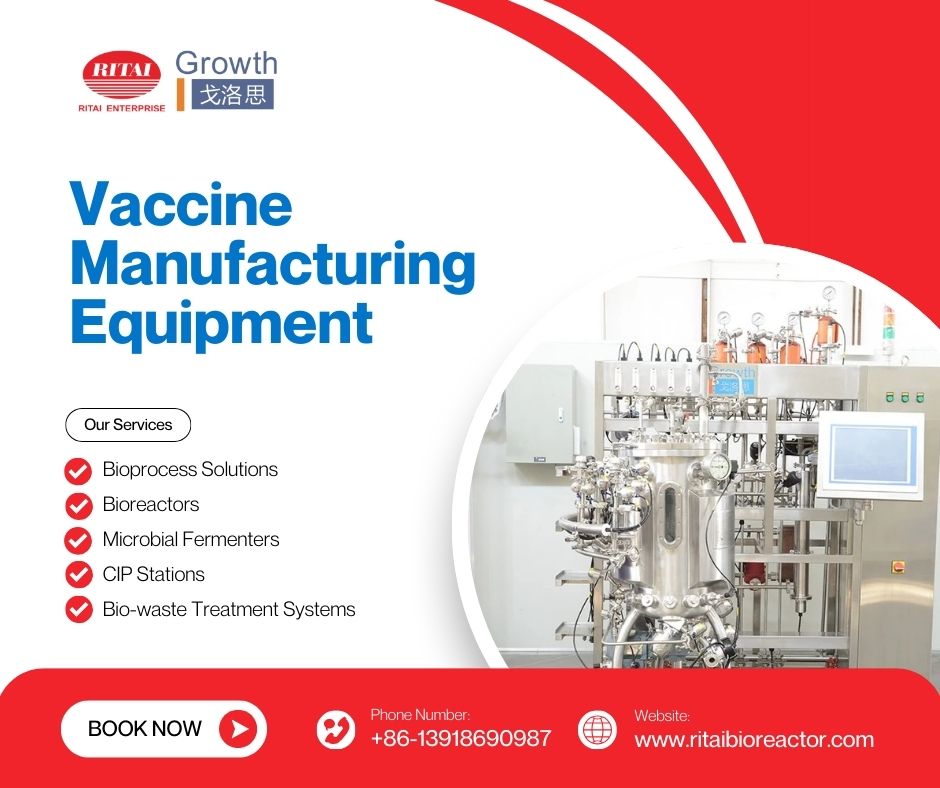
When people talk about vaccine production, the spotlight usually lands on antigens, adjuvants, and cold-chain logistics. But on the plant floor, outcomes often hinge on something less glamorous: Vaccine Manufacturing Equipment decisions that either make scale-up smooth—or turn it into an expensive troubleshooting marathon.
If you’ve ever watched a process behave perfectly in a lab flask and then drift the moment it hits a larger vessel, you already know why equipment matters. The goal isn’t to buy the biggest stainless tank and call it a day. The goal is to build a line where each unit operation supports consistent quality, cleanability, and data integrity, while still being practical for your team to run.
In this guide, I’ll walk through how to evaluate Vaccine Manufacturing Equipment from upstream to fill-finish, where a Pilot Scale Fermenter fits, and how brands like Ritai Bioreactor can be positioned in a realistic development-to-production path.
What Good Vaccine Equipment Looks Like in Real Life
Before listing machines, it helps to define what success means. Strong Vaccine Manufacturing Equipment choices usually share a few traits:
- Repeatability: batch-to-batch control with stable mixing, oxygen transfer, temperature, and pH.
- Clean design: hygienic connections, proper drainability, and validated CIP/SIP where applicable.
- Right level of automation: alarms, trends, audit trails, and recipe control without overcomplicating operations.
- Scale logic: a clear bridge from development to clinical and commercial volumes.
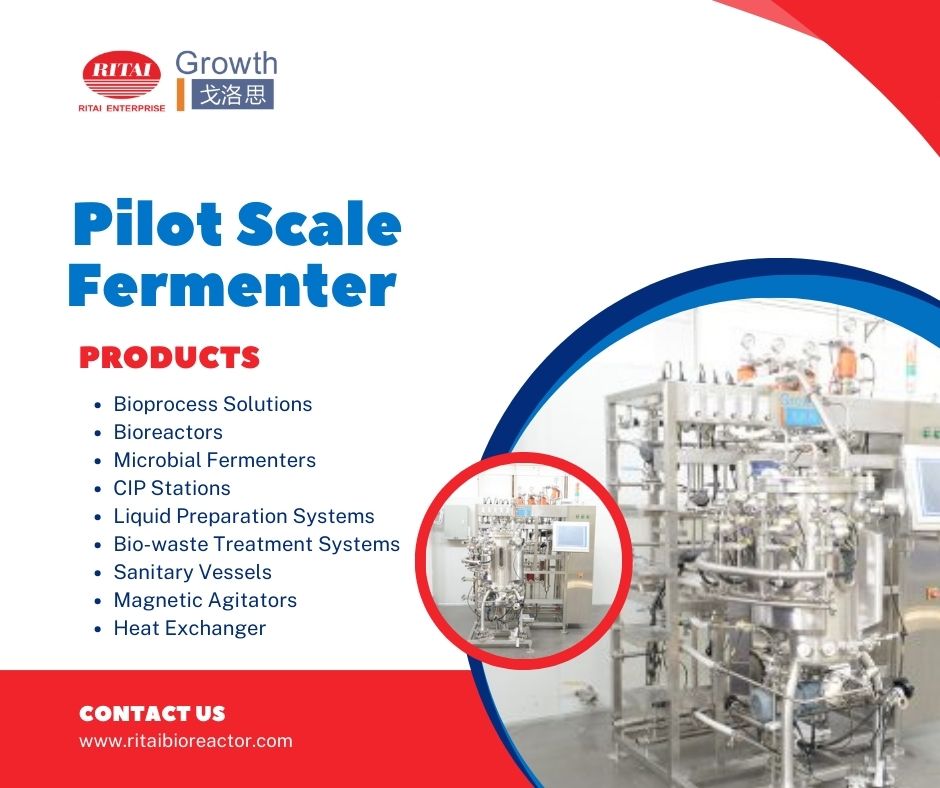
A Pilot Scale Fermenter is often the linchpin here. It’s where promising becomes transferable. If your Pilot Scale Fermenter is poorly matched to your eventual production approach, you can end up re-learning the process at each scale step.
Upstream: The Core of Vaccine Manufacturing Equipment
Upstream is where you build the antigen (or antigen precursor), whether you’re working with microbial expression, cell culture, or viral systems. Your upstream Vaccine Manufacturing Equipment is responsible for creating the environment where biology behaves consistently.
Seed Train Systems
A typical flow is shake flasks → seed bioreactor → Pilot Scale Fermenter → production bioreactor. Each step needs consistent geometry and control philosophy. When your seed vessels don’t “feel” like your larger units, scale-up becomes guesswork.
Bioreactors and Fermenters
Your main Vaccine Manufacturing Equipment decision upstream is the bioreactor strategy:
- Stainless steel for long-term campaigns and broad chemical compatibility
- Single-use for faster changeovers and reduced cleaning burden
For many teams, a Pilot Scale Fermenter is where they validate mixing, gas transfer, foam control, and feeding strategies under tighter control. This is also where you confirm sensor reliability and establish data you can defend during tech transfer.
If you’re evaluating Ritai Bioreactor options, focus on practical details: controller usability, spare parts lead time, sensor integration, agitation range, and how easily operators can run the system without “tribal knowledge.”
Why a Pilot Scale Fermenter Matters More Than People Admit
A Pilot Scale Fermenter isn’t just a bigger tank. It’s a test of your entire control strategy.
Here’s what you can learn quickly with the right Pilot Scale Fermenter:
- Oxygen transfer limits: Do you need higher agitation, more sparging capacity, or pure oxygen?
- Mixing time: Does your feed distribute evenly, or do you get gradients that hurt yield?
- Foam behavior: Are you relying on antifoam as a crutch, or is your gas strategy stable?
- Heat removal: Can you control temperature under peak metabolic load?
This is why your Pilot Scale Fermenter should be treated as essential Vaccine Manufacturing Equipment, not nice to have. If you plan to scale further, your Pilot Scale Fermenter is your rehearsal stage.
Downstream: Where Vaccine Manufacturing Equipment Protects Quality
Downstream is often where production teams spend the most time debugging. The biology may be done, but impurities, shear sensitivity, and recovery losses can quietly destroy project timelines.
Key downstream Vaccine Manufacturing Equipment typically includes:
Cell Harvest and Clarification
- Disc-stack centrifuges (for robust systems)
- Depth filtration (common and scalable)
- Microfiltration/TFF (especially for gentler handling)
Your choice of clarification tools should match your upstream. If your Pilot Scale Fermenter produces variable cell density or viscosity, your harvest step needs margin.
Chromatography and Purification
- Affinity or ion exchange columns depending on antigen type
- Multimodal resins for tricky impurity profiles
- Skid automation that supports reproducible recipes and logging
This is another area where Vaccine Manufacturing Equipment decisions impact compliance. Data trails and consistent operation matter just as much as recovery numbers.
Viral Inactivation and Polishing
If your platform requires viral clearance steps, build equipment selection around:
- validated hold vessels
- temperature control stability
- mixing strategy that avoids dead zones
Again, your Pilot Scale Fermenter data can inform impurity load and help size these steps intelligently.
Formulation and Fill-Finish: The High-Stakes Zone
Fill-finish is where many vaccine programs feel the most pressure. It’s also where Vaccine Manufacturing Equipment needs to align with regulatory expectations and practical plant realities.
Common fill-finish Vaccine Manufacturing Equipment includes:
- sterile filtration skids
- formulation tanks with low-shear mixing
- aseptic filling lines (vials or syringes)
- lyophilizers (if freeze-dried presentation is required)
- capping and inspection systems
If you’re in development, you don’t need a full commercial line on day one. But you should design your Vaccine Manufacturing Equipment pathway so you can scale without rewriting the whole process.
Facility Utilities: The Hidden Vaccine Manufacturing Equipment
People underestimate how much a project depends on utilities. A well-chosen Pilot Scale Fermenter won’t save you if your plant utilities are unstable.
Make sure your Vaccine Manufacturing Equipment plan covers:
- WFI/PW systems (as required by your process)
- clean steam and pure steam distribution
- compressed gases (air, oxygen, nitrogen, CO₂)
- HVAC zoning and pressure cascades
- waste decontamination strategy
Utilities aren’t optional background details; they’re part of the Vaccine Manufacturing Equipment ecosystem.
Selection Checklist: How to Choose Equipment Without Regrets
If you’re comparing Vaccine Manufacturing Equipment suppliers, here’s a practical checklist that works in real projects:
1) Match Equipment to Your Process Platform
Microbial, mammalian, viral vectors—each has different needs. A Pilot Scale Fermenter optimized for microbial work may not fit delicate mammalian cells.
2) Demand Usable Automation
Look for:
- recipe control
- audit trails where needed
- alarm and event logs
- easy data export
Overly complex systems slow teams down. Simple, reliable control wins.
3) Think in Changeovers and Maintenance
Ask blunt questions:
- How long does a turnover take?
- What are the common failure points?
- How easy is calibration?
Brands like Ritai Bioreactor are worth evaluating not just for specs, but for how they support day-to-day operations—training, documentation, and service responsiveness.
4) Validate Scale Path Early
Your Pilot Scale Fermenter should reflect your intended production strategy. Similar impeller types, comparable gas delivery options, and consistent control logic reduce scale surprises.
A Realistic Example: From Pilot to Production
Let’s say you’re developing a recombinant protein antigen.
- You run early development in bench bioreactors.
- You move to a Pilot Scale Fermenter to lock feeding, DO strategy, and harvest timing.
- You validate clarification and chromatography loads based on Pilot Scale Fermenter output.
- You confirm formulation stability and then plan fill-finish.
In this path, the Pilot Scale Fermenter becomes the truth source for scale-up decisions. It also acts as a training ground for SOPs, deviation handling, and batch documentation—critical parts of Vaccine Manufacturing Equipment readiness that don’t show up in a brochure.
Where Ritai Bioreactor Fits
If you’re considering Ritai Bioreactor for your line-up, a sensible approach is to map it to your stage:
- Development teams can benefit from consistent controls that mirror later stages.
- A well-specified Pilot Scale Fermenter from Ritai Bioreactor can reduce process drift when you scale.
- For facilities building long-term capacity, aligning upstream Vaccine Manufacturing Equipment and training around a stable platform can speed tech transfer and reduce operator errors.
The key is to evaluate Ritai Bioreactor the same way you’d evaluate any serious supplier: documentation quality, validation support, service SLAs, spare parts availability, and proven integrations with your sensors and software stack.
Final Take
Choosing Vaccine Manufacturing Equipment isn’t a shopping exercise—it’s process strategy. The best teams pick equipment that supports repeatable biology, defensible data, and smooth tech transfer.
If you take only one thing from this: treat the Pilot Scale Fermenter as a critical decision point. A strong Pilot Scale Fermenter makes upstream predictable, downstream sizing realistic, and scale-up far less painful. And if you’re exploring options like Ritai Bioreactor, judge the platform by how it performs in real operations, not just on paper.
Because when the pressure is on and timelines are tight, the right Vaccine Manufacturing Equipment doesn’t just help you produce batches—it helps you keep promises.